One of our earlier articles explained how many AI jobs are old jobs with a new title. Nowhere is this truer than software engineering.
Today’s AI engineer is a developer who builds on top of models. That could mean connecting systems to models, feeding them the correct data, or shipping features to users. And although AI engineers produce entirely unique tools for the AI age, the fundamentals are identical to traditional software engineering. What differs is the AI engineer’s understanding of how models behave and how their outputs can vary.
As a candidate for AI engineering jobs, you need to show your knowledge of these differences to the hiring manager. Your portfolio is the tool to make it happen.
Thankfully, this doesn’t mean your portfolio needs a complete rewrite when applying for AI engineering roles. This article walks you through how to restructure your software engineering portfolio to help land your next job in AI.
Step 1: Assess your current portfolio
You can keep in all the work that shows those fundamental engineering skills still relevant to an AI role. That includes production code for live software, APIs, system design, testing, and projects that show scalability to handle a large volume of users.
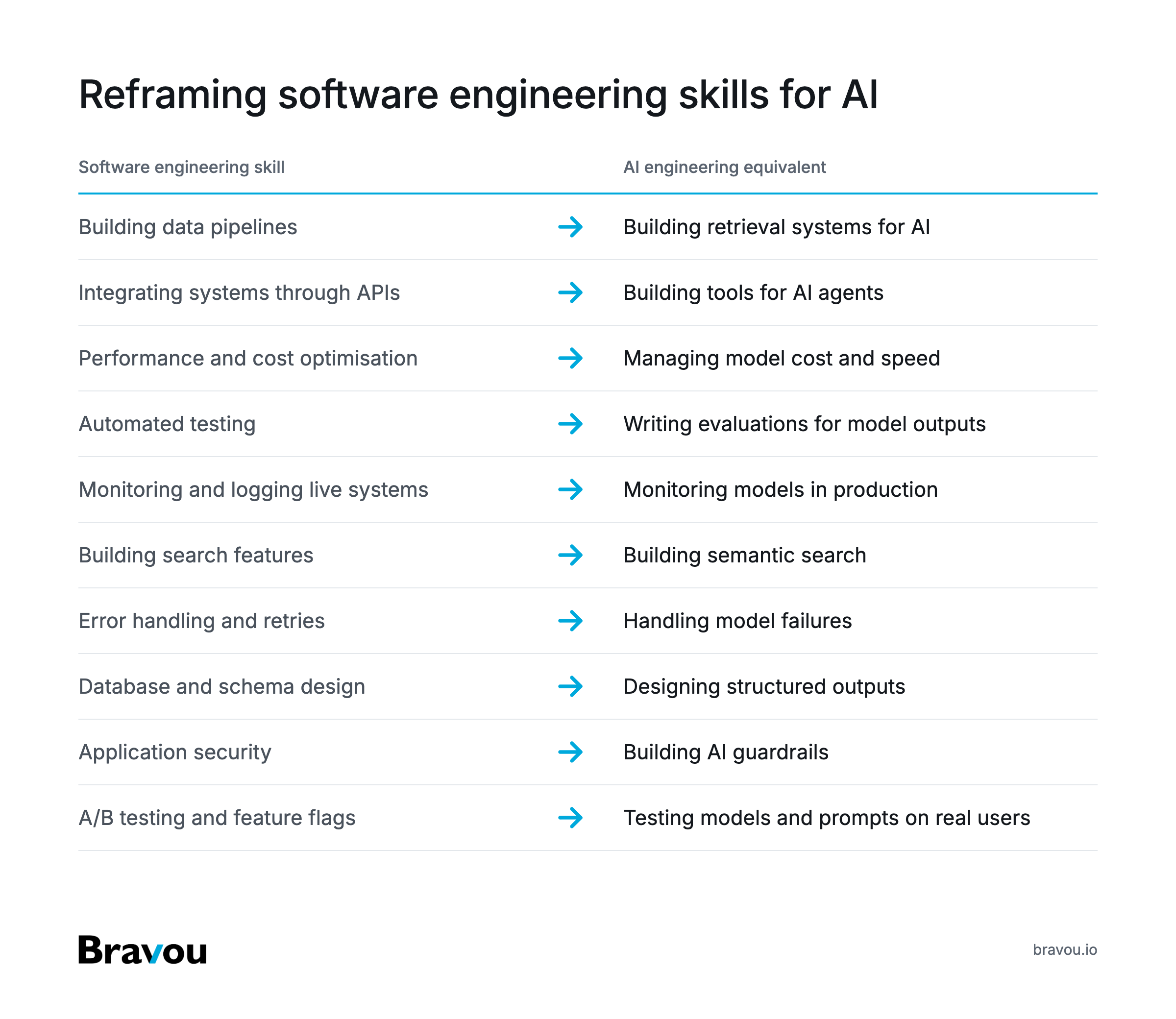
Next, reframe those skills to relate to AI-based systems. This shows how your current knowledge bridges to AI. For example, an integration project relates to agent tooling, while the build of data pipelines is similar to retrieval systems for AI. Below are more examples to help define your own.
Here, it’s obviously not about fabricating your experience. Any explanations of live projects should be purely factual. Instead, your portfolio’s introduction or about section should demonstrate what you’ve built so far and how that carries over to AI engineering. The same can be included in a cover letter or CV intro.
Step 2: Add completed AI projects
If you have live AI projects to point to, include them, and ideally, projects that show different skills.
For example, hiring managers would be interested to see how you’ve built systems that lead models to take actions, rather than just ask questions. And to stand out, consider showing projects that demonstrate tasks run through multiple models, with a report on quality, cost and speed. The ability to choose the right model for the job is rarer than you might think.
If you’re reading this concerned you have no live AI projects to show, don’t be too concerned. You could commit to building one small, complete project that solves a problem you can confidently talk through with the hiring manager. Alternatively, you could join a hackathon to contribute to a working project on a deadline.
Getting that one project live might mean sacrificing a few evenings and Saturdays, but it’s a valuable edge that will elevate you above other candidates.
Step 3: Show your problem solving
It’s relatively easy to show you have software engineering skills. Hiring managers for AI roles want to see your problem-solving skills. You can do this by showing how you made decisions when building projects.
Consider the following as you build out the explanation of an AI engineering project:
· Evaluation: how you tested the quality of the AI’s answers, including results if you can
· Cost and speed: the time and related cost for your project to complete one full task. The hiring manager will want to see how you weighed cost and speed against quality, in the context of what’s being built.
· Failure handling: how the AI responds when it gets something wrong. This is only becoming more important as automation finds its way into more high-assurance areas: autonomous driving, healthcare and finance for example.
· Trade-offs: an explanation of the trial-and-error process you went through to land at the final build. Include the reasoning behind what led you to the trade-offs you settled on. For example, why you accepted lower accuracy for faster answers.
Step 4: Make the hiring manager’s life easier
Simplify the hiring manager’s job, and they might thank you for it. Most won’t have the time to download and run code themselves. Help them by including live demo links to your projects, along with a README file explaining what you did and why.
Also consider including screenshots or a short GIF of your project can speed up their understanding. Hugging Face Spaces is a free way to host your demo.
The advantages for Gulf candidates
If you’re already Gulf-based and have local AI engineering projects to your name, you’re in a strong spot versus international candidates.
First, Arabic and regional projects stand out because you can demonstrate judgement and problem solving relevant to the context of building systems in the region. For example, a retrieval app for Arabic-language models isn’t something an international candidate can match.
Meanwhile, a lot of AI projects in this region sit under an NDA. That might seem limiting, but it means your side projects matter more in a portfolio, and you have greater control over what those projects show.
The final word
Software engineers, like most others, are seeing their specialism disrupted by AI. For those wanting to move with the tide and secure an AI engineering role, their portfolio also needs to adjust. Making that change doesn’t need to be a heavy lift if you can gather evidence of AI-related skills or better yet, live projects.