If you’ve reached the point in your AI job search where something needs to change, start with positioning. Just as marketers use product positioning to target those most likely to buy, you can position yourself as the candidate most likely to succeed.
Our latest article explores what positioning is for AI job hunters in the Gulf and how to write your own candidate story.
What is ‘positioning’ for job seekers?
Product positioning and applying for roles share many similarities.
In their revolutionary book Positioning: How to be seen and heard in the overcrowded marketplace, authors Al Ries and Jack Trout describe positioning as “the first body of thought that comes to grips with the difficult problem of getting heard in our overcommunicated society.”
Just as society is overcommunicated, the job market is oversaturated. Hundreds of applications within hours of a role going live is now the norm. With such high competition for jobs, it’s no longer enough to tick all the boxes on your CV.
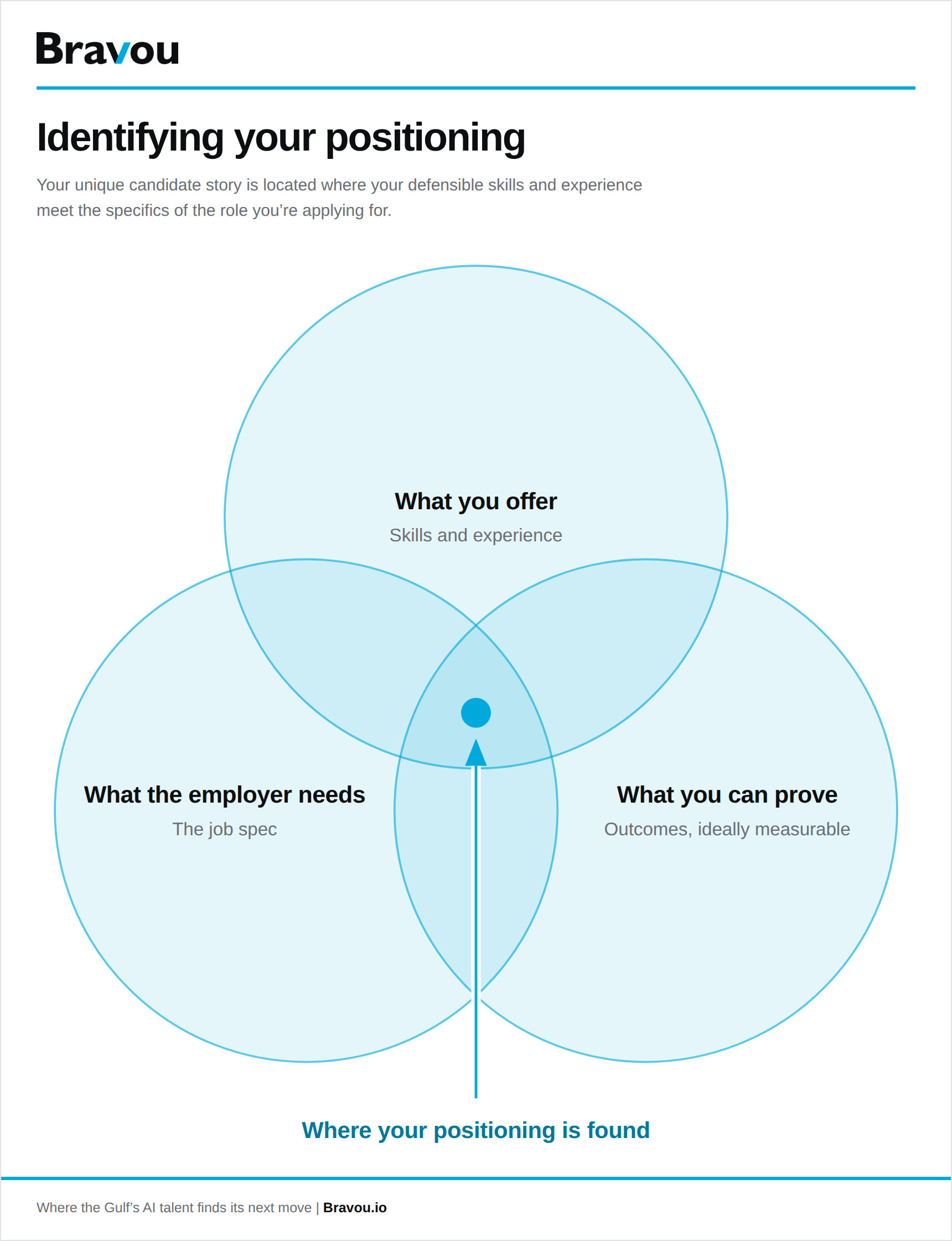
Positioning places you away from all other candidates where your unique attributes and perspective get the attention they deserve. It’s about defining, with complete authenticity, how you’re different and better than other candidates. It’s the reason why an employer should choose you over others.
This is especially valuable in the Gulf.
According to Boston Consulting Group, 40% of UAE and 42% of Saudi companies can be categorised as AI leaders, above their global peers. What’s more “sustained investment in digital infrastructure, AI solutions, data, and specialized talent - underpinned by ambitious national transformation agendas and organizational ambitions - have further consolidated the GCC’s position as a regional hub for digital and AI leadership,” say BCG.
As the region’s AI maturity continues to grow, so too will the competition you’re up against.
How to define your positioning
How do you identify what makes you unique as a candidate before putting it on paper?
· Start with the job spec. Once you have a job spec for a role you’re genuinely qualified for, reverse engineer the role and responsibilities blurb to make connections between what they’re looking for and what you’re skilled in.
· Next, rank those skills. List, in order of strength, your identified relevant skills. To decide the ranking you could consider your years of real-world experience, strength of your evidence, and your confidence applying the skills today.
· Inject your past experiences. With your skills ranked, add to that a list of relevant professional experiences. How is an experience different from a skill?
Experiences are a combination of the companies you’ve worked for, their context, and their industry. The ‘context’ here is key. It refers to whether the company was a start-up or Blue Chip, whether they were scaling or diversifying, and whether they were a market leader or a challenger brand. These characteristics add to the uniqueness of your experience. Skills, meanwhile, are the capabilities you’ve acquired through experiences.
· Attach proof to skills. This is where you add authenticity. Against every skill on your list, add an outcome that proves it. Ideally, this will also be measurable: what changed, by how much, and over what period. If there’s no evidence of a skill, strike it off the list, because then it’s only a claim. Other candidates will make hollow claims, but you’ll immediately leap above them with proof.
· Now cut. By now you’ll probably have a list of eight or nine skills with proof attached. Cut that back to just the strongest two that are most relevant to the role. Rather than a summary of your career, positioning is a soundbite for why you’re uniquely suited to the role.
Put your positioning on paper
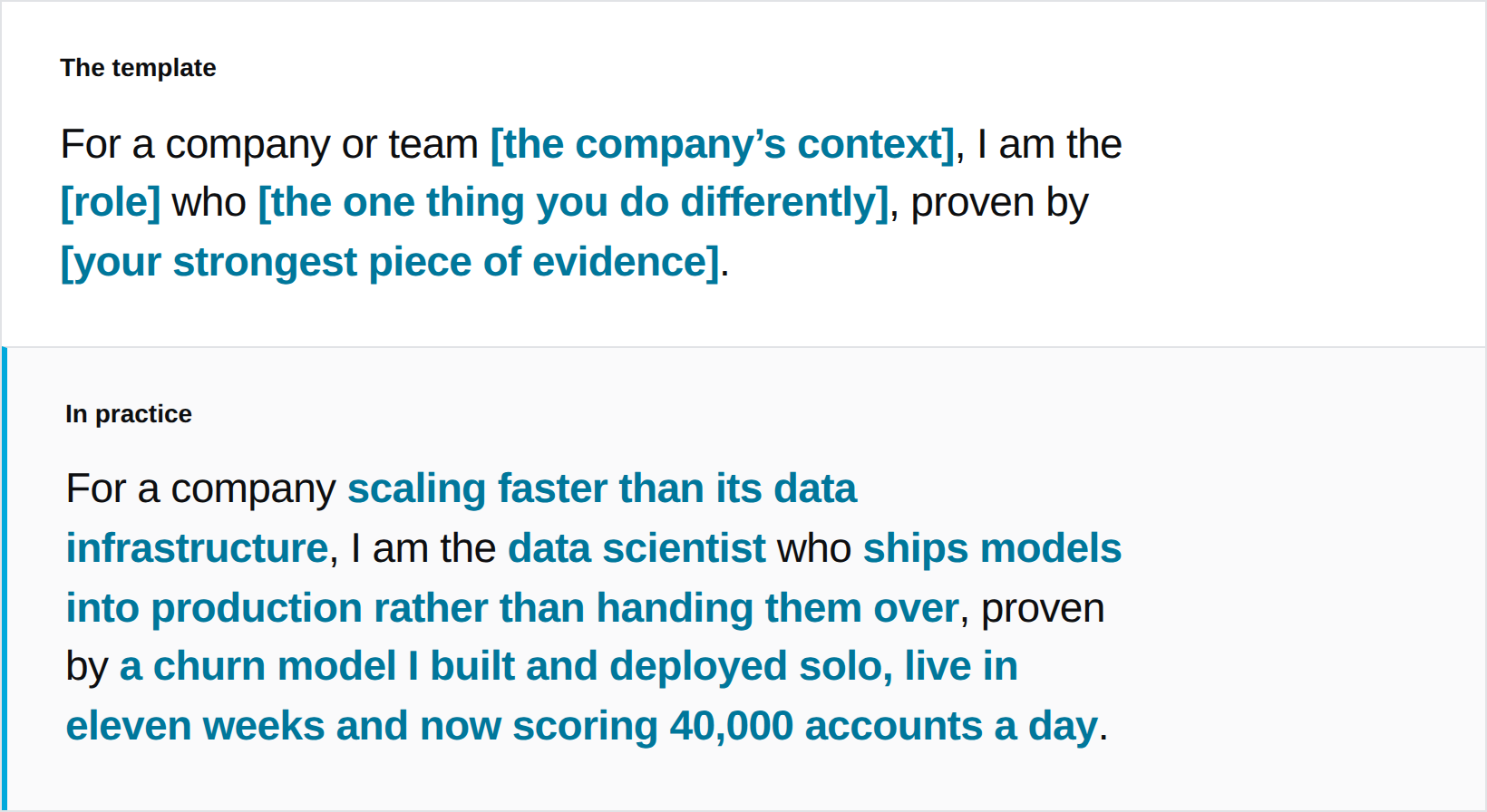
Writing your positioning as a statement gives you an elevator pitch for interviews and an anchor for anything you write in your CV, cover letter, portfolio, or any other resource seen by the hiring manager. Use the template below to craft your own positioning. Also included is a completed example to guide your thinking.
When and how to use your positioning
You’ve put the effort into creating a positioning statement that speak directly to your unique capabilities and background. When, and how, should you apply it?
First, never publish the final statement you land on. It’s a non-public passage you draw from when you’re applying the positioning to whatever touch point needs it. Instead, work the statement into your cover letter and CV intro. Because these formats will generally be longer in words, you can then repurpose the relevant passage for all other shorter touchpoints.
One key thing to remember: be sure to repeat the phrasing you use to describe your position, everywhere you use it. Repetition creates recall, giving the statement more power. You can apply that phrasing to:
· CV summary: Keep this in the tone of your wider CV. As the intro is all about you, include only the difference and evidence.
· Top three bullets in your current role: Reordered so the proof in your statement is read first.
· Cover letter, second paragraph: Intro your interest in the role, then jump straight into difference + evidence.
· LinkedIn headline: Stay consistent so your LinkedIn profile ties directly to your CV.
· “Tell me about yourself statement”: Expand your statement to 60 seconds, and practice saying it aloud for the most natural articulation.
The final word
Taking the time to define your positioning is a candidate can pay dividends throughout the job search, especially in the increasingly competitive AI jobs market. Not only does authentic and genuine positioning help you craft a focused and effective CV and cover letter, it also arms you with a succinct explanation of why you’re unique to use in interviews. Hiring isn’t easy, and hiring managers place great value on candidates who communicate with clarity and brevity. A positioning statement helps you do exactly that.