Whether they know it or not, hiring managers leave hidden clues peppered throughout job specs signalling what they’re really looking for. Spot them, and you’ll uncover insights that can position your application above the rest. In the increasingly competitive market for AI jobs in the GCC, that's an edge you can't overlook.
This article outlines the most common hidden clues to look for and how to apply them to your next job application.
Start by reading the job spec four times
When you read the job spec multiple times with a different intention on each pass, you’ll uncover new insights each time. It’s a method editors use to properly scrutinise a text for errors, then brevity, then pacing, and so on.
On pass one, look for the pain. The pain is the reason why the role is open. Maybe someone left and the team lacks a leader or specialist. Or, something might need to be built. Identifying the pain gives you context for the open position. Shape your evidence to this context (more on that below) and you’ll get noticed.
On the second read, identify repetition. At Bravou we often see unintentional duplication throughout specs, usually the same information written differently. Repetition spotlights the hiring manager’s priority. Multiple references to “translating technical concepts for business audiences” suggests this wasn’t done well before and is an example to emphasise when explaining past projects.
Pass three looks for what’s missing. No mention of success metrics suggests they’ve not been defined. No reference to the team implies you’re the first hire, or a replacement for the previous first hire. These gaps exists because the hiring manager either hasn’t identified them or chose not to advertise them. Either way, consider gaps to be topics with no competition from other applicants, and therefore something to emphasise in your CV and cover letter.
During pass four, look for the most human language. Job specs are written by multiple team members, each adding their own requirements. Legal will often drop in a generic boilerplate with a dry and jargon-heavy tone. The most human language typically comes from the hiring manager, and that’s who you need to engage. Consider their part to be the core of the role and build your application around what they’re looking for.
Identifying tells
Next, tells. They’re the subtle phrases or structural elements of the job spec that reveal what’s most important. Here are the seven most common.
1. Requirement order: In the bullet point list of a role’s requirements, consider the first three to be 80% of the job. Focus your evidence on these areas but be prepared to explain the rest.
2. Named tools versus categories: If a tech stack is named, you’re safe to assume it’s live and waiting for you. If instead you see “familiarity with cloud platforms”, you might find they haven’t decided yet, and the early weeks are about building rather than optimising.
3. Verb tense of the mission: ‘Establish’, ‘define’, and ‘build out’ all point to a plan you’ll need to bring to life. ‘Optimise’, ‘scale’, and ‘maintain’ suggest an existing system you’ll inherit and steer. Adjust your experience depending on which.
4. Seniority mismatch: Some roles show a leadership title, but the job spec is mostly executional with no mention of mentorship. Get clarity on this discrepancy early to understand whether the day-to-day reality of the role meets your ambitions.
5. An overlapping scope: A role scope that asks for data engineering plus modelling, deployment, and stakeholder management probably means you are the team. If that’s the case, emphasising your comfort operating alone is a plus. Otherwise, it suggests you need a structure that won’t be available.
6. The reporting line: Who you report into tells you where the function sits in the wider business, and whose language to write for. If your manager is C-suite, lean towards big-picture strategy and commercial outcomes backed up by data you can defend. If it’s a technical head, you can use precise terms the layperson might not understand.
7. Urgency markers: Phrases like ‘immediate start’ and ‘urgent requirement’ signal the team’s circumstances. They’re also leverage you can use to your advantage if you have a short or no notice period. Dropping your availability into the cover letter can pique the hiring manager’s attention.
How to turn clues into evidence
Many applicants will identify clues in the job spec and swap out a few adjectives as ‘evidence’ of why they’re the right fit. Instead, it’s worth putting the time in to changing what you’re proving. This is where the same career is explained from a different angle. Here's how.
Take a blank page and make three columns: the subtle clues of what the spec is really asking for, what you can prove, where this proof is placed. Below is an example of what this looks like, based on the clues we’ve explored above.
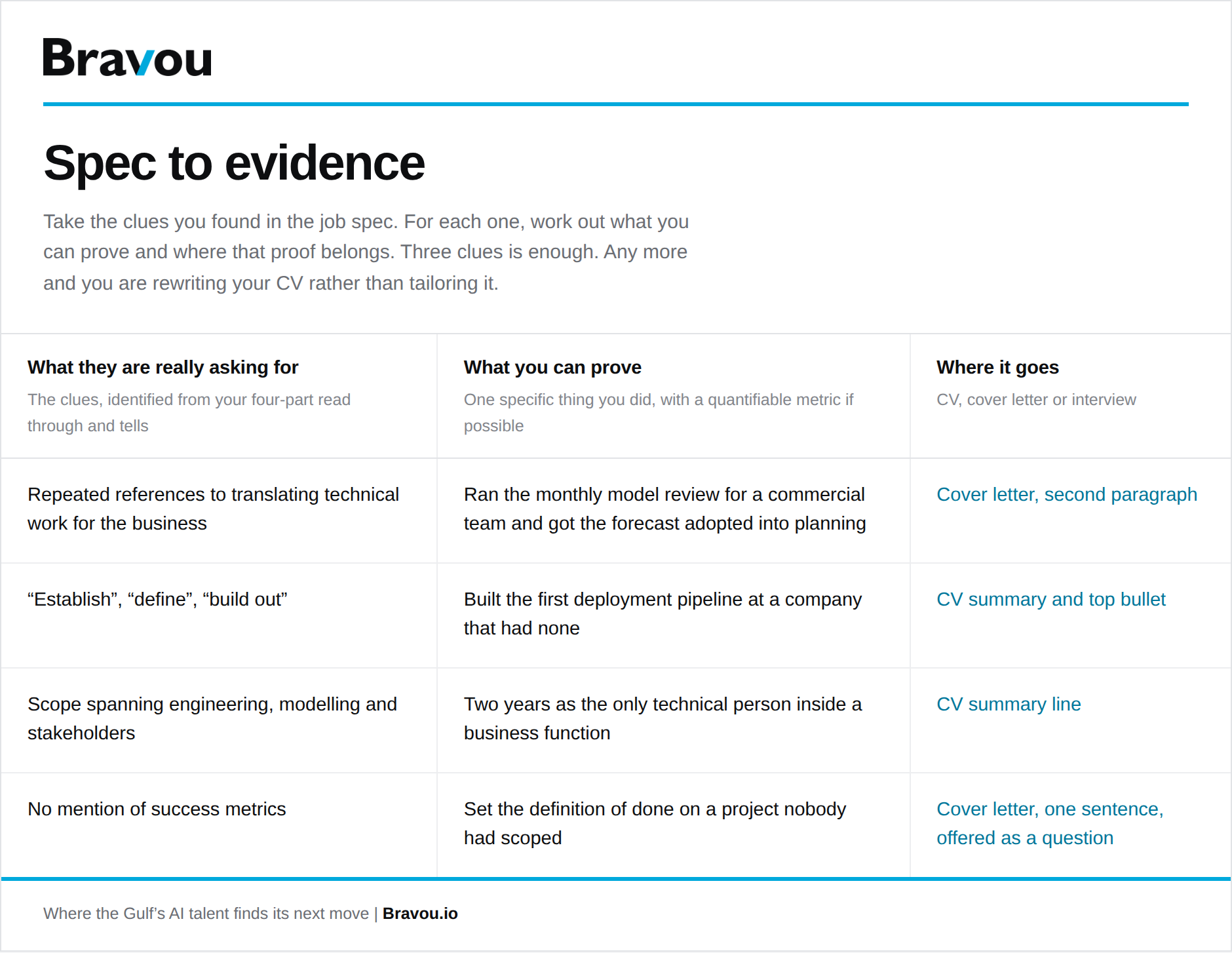
With this analysis complete, you'll be left with something of a cheat sheet to guide how you tailor each application for the specific job in question.
The final word
We know the job search can be an exhausting grind. But, taking a little more time to identify the clues in a job spec before tailoring your CV and cover letter is always worth the effort. It could mean the difference between an interview opportunity and a passed over CV.