Are AI certificates the golden ticket to securing an AI role in the Gulf many job seekers think they are? We looked at the data to find out.
In October, we read 104 AI job specs from Bravou and the wider Gulf market to log every mention of a certificate.
Three quarters of the job specs analysed never mention a certificate. Most of the others list a certificate as “preferred” or “an advantage”. Only two of the 104 make one a requirement: a Scrum Master role, and an AI engineer role that will also accept “equivalent credentials”.
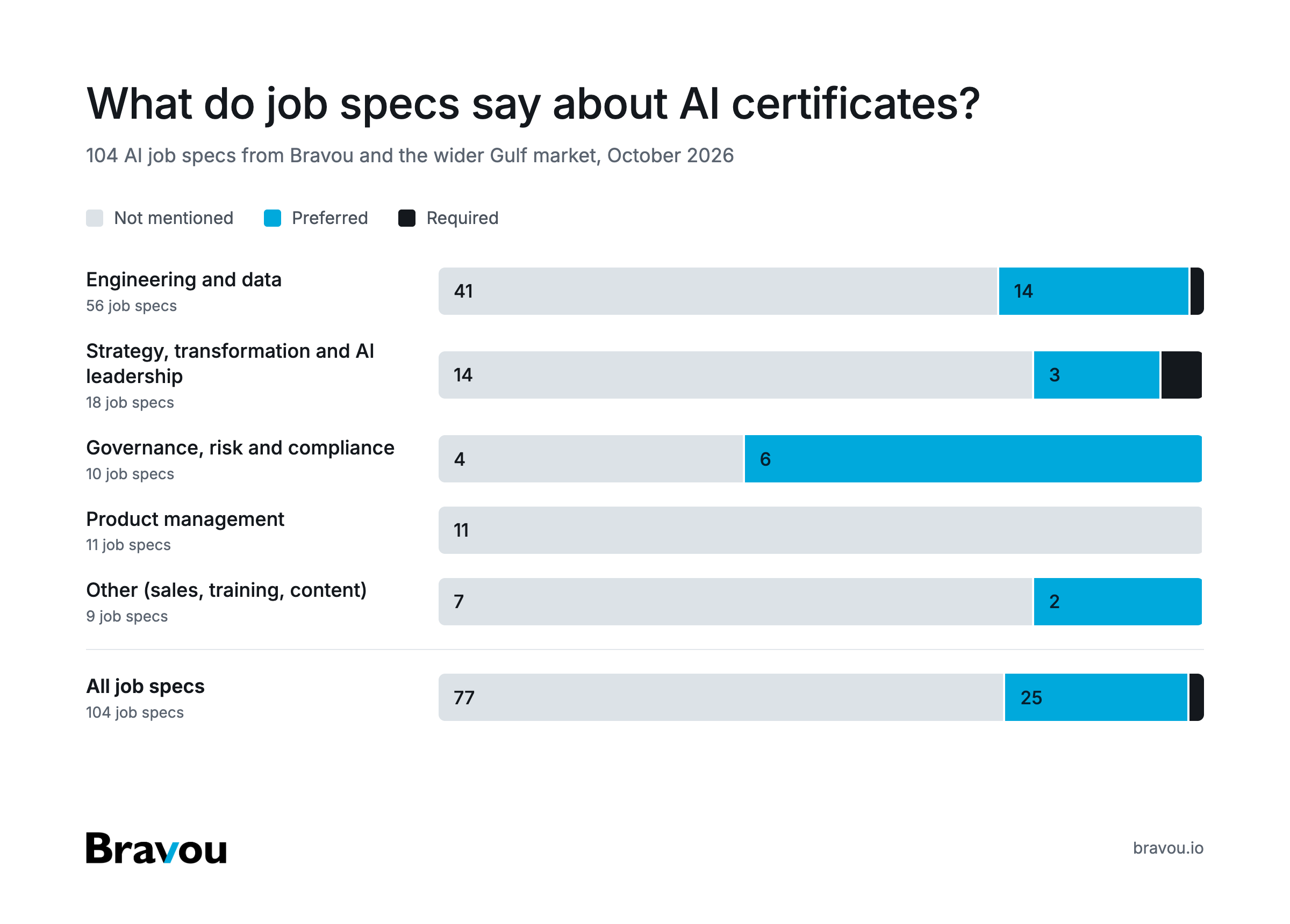
Where do certificates show up?
We found that the certificates employers name are rarely AI courses. Instead, they’re the credentials each profession has expected for years, attached to jobs that now include AI tasks.
So, do I need an AI certificate?
That depends on the category of AI jobs you’re applying for.
Engineers and data scientists. 15 of the 56 engineering specs mention a certificate and 13 of those mention cloud: AWS, Azure, Google Cloud or Databricks. A cloud certificate is the most influential to hold when applying for this category of role. Beyond that, your free time is better spent on a project with results you can talk through in an interview, and include in an AI-focused portfolio.
Governance, risk and compliance. The data highlighted this group as the exception. Six of the 10 specs we reviewed mention a certificate, mostly risk and security credentials such as CRISC, CISM and CISA, with CIPT for privacy. ISO 42001 was referenced once. If you already hold one of these certificates, it’s worthwhile to add AI knowledge on top. If you don’t, prioritise the ‘traditional’ non-AI certificate.
Product managers. None of the 11 product specs mentioned a certificate. That suggests hiring managers want to see an AI feature you shipped and how you measured its success.
Strategy and transformation. Four of 18 specs mention a certificate, mostly project management and agile credentials such as PMP, PRINCE2 and Scrum. Again, this tells us that a record of AI adoption you’ve led, with performance numbers included, will be more influential than a certificate.
Tip: read the wording carefully
We found that when a spec does mention a certificate, the wording usually reveals clues about what the employer is looking for and how strict the requirement is.
For example, one AI engineer role in our sample lists certifications under its requirements, then adds “or equivalent credentials”. A governance role in Riyadh asked for “familiarity with or certification in” ISO 42001.
Either way, the employer’s sole priority is to prove you have the required knowledge. Evidence could come from a certificate, but in many cases a live project you can walk them through is enough. The certificate might not always be needed.
The final word
Certificates are undeniably valuable for job seekers, and in certain circumstances they could mean the difference between landing a job or not. The strength of their influence depends on the employer, the role itself, and crucially, what project examples you can show to demonstrate the same knowledge.
Before you pay for an exam, take the time to analyse multiple job specs for the role you’re pursuing. If none of them mention a certificate, consider instead putting time into a project that demonstrates your practical understanding of what’s being asked for.