AI’s noise is deafening in today’s market. Not only are companies committing ‘AI washing’ by claiming to be AI-champions without the credentials, but many job seekers are tagging AI onto their profiles as a way of appearing relevant.
It’s precisely why you should stop calling yourself an AI specialist. The label communicates nothing meaningful to a hiring manager today. Instead, there’s much more value in being ultra-specific about how you apply automation and the positive outcomes you’ve achieved. This article explains how to achieve just that.
AI washing is on the rise
Back in 2025, LinkedIn CEO Ryan Roslansky revealed that job postings mentioning AI had risen sixfold over the previous year. Across the same period, users adding an AI skill to their profile rose 20x.
Meanwhile, recent research from Revelio Labs found that nearly one in five LinkedIn profiles had been edited to retroactively add AI skills to past jobs. According to the research, “since the release of ChatGPT in late 2022, retroactive additions of terms including “AI,” “GPT,” “LLM,” and “artificial intelligence” have increased more than sixfold”.
As more companies hire for AI skills, more candidates are bending the truth about their automation capabilities. When everyone claims to be an AI specialist with no real substance, the term loses its power.
Instead, wherever a hiring manager sees your profile, you need to go one layer deeper and communicate your exact specialism, backed up with hard evidence. A lack of specifics could be killing your job search.
What do hiring managers want?
One of the most widely cited studies on recruiter behavior comes from US careers platform Ladders. Using eye-scanning software, the research found that recruiters spent six seconds on an initial scan of a CV, mostly on the current title, employer, dates and keywords. Although that may seem worrying, it’s just one example, not the rule for all recruiters.
However, with ATS (Application Tracking Software) now automating much of the CV review process for hiring managers, it’s never been more important make sure your application holds the right keywords and makes your specialism crystal clear.
Here’s what hiring managers want from your CV:
· Speed: As explained above, hiring managers are making a decision about your CV in seconds. You therefore instantly need to give evidence of why you’re qualified for the role. Put keywords in the CV headline or intro passage and don’t be afraid to repeat them throughout. That makes sure they’re seen in a quick scan.
· Specificity over adjectives: It’s not enough to claim you’re a ‘results-driven data scientist’. Again, you need to go one layer deeper to demonstrate what those results are, and the project they relate to. Include a named tool, method or problem and back it up with quantifiable data.
· Evidence they can view quickly: Time poor hiring managers want a portfolio, GitHub link, or published case study they can click and instantly see you’ve got the evidence to back up your talk. Achieving that immediately elevates you above so many other candidates.
How to show your specialism
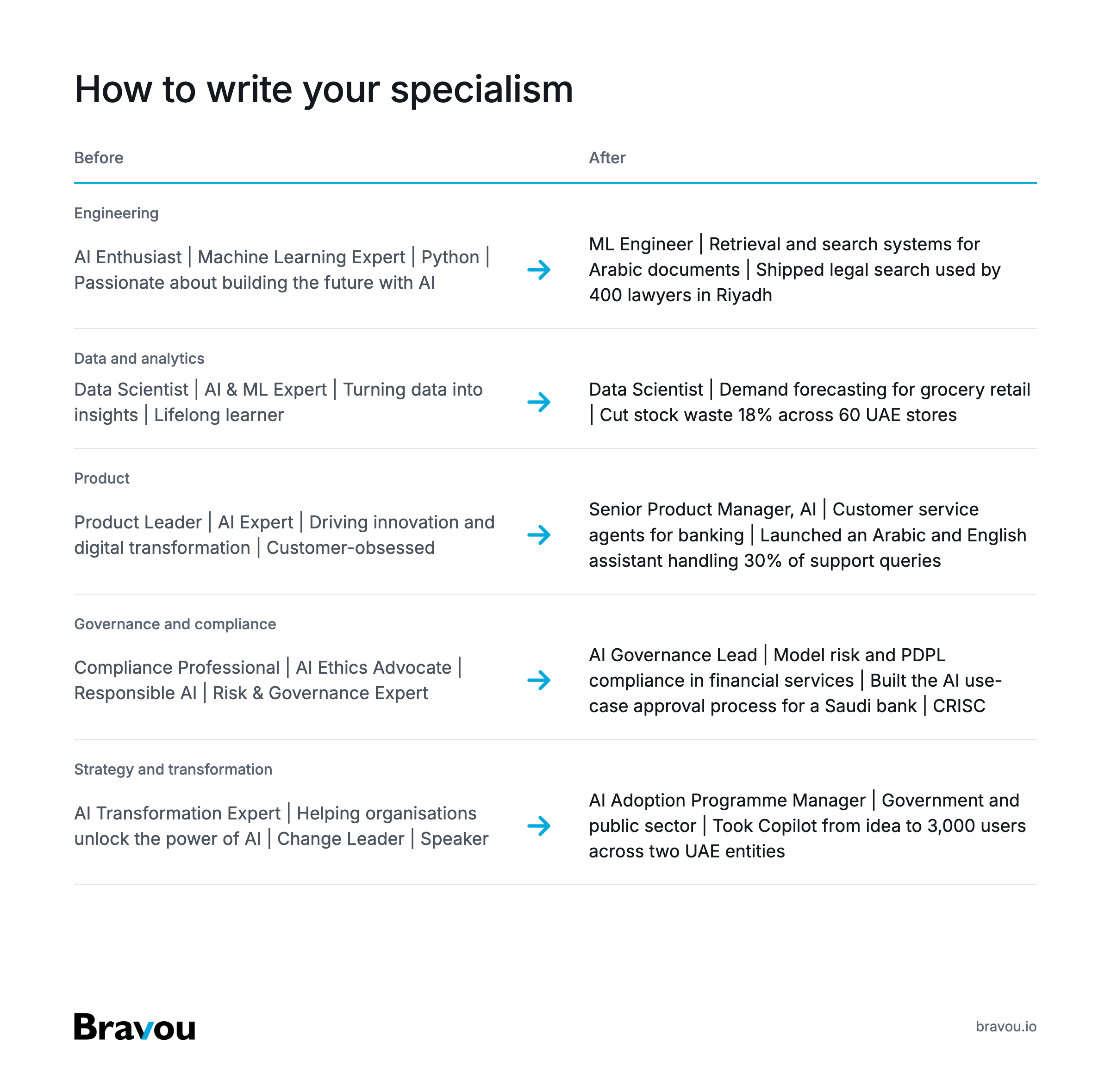
There’s a simple formula you can use in your CV, cover letter, or LinkedIn bio to quickly and effectively show your AI specialism: role + specialism + proof point.
For example: Data Scientist | Demand forecasting for retail | Cut stock-outs 18% at [company].
You can also apply the following test to your headlines to see if it’s got a strong chance of passing recruiter scrutiny:
1. Would a recruiter search for these words?
2. Could someone else in your field write the same headline? If yes, it’s too generic.
3. Can you back up every claim in an interview?
You can keep ‘AI’ in, but only where it’s attached to something specific. For example, when giving evidence of your role in ‘AI governance’ or ‘AI engineering’. Meanwhile, localising your headline and adding a sector specialism is another layer of detail that can work in your favour.
What we’re describing above is part of the process of positioning yourself as a candidate, so your unique attributes and perspective get the attention they deserve. We wrote a whole article explaining how to define your positioning, which we recommend you read here.
What a strong AI headline looks like
To help you apply the guidance above to your own application, below are five examples of before and after edits made to hypothetical AI application headlines.
The final word
In a job market that’s growing increasingly competitive, identifying and communicating your specialism can instantly position you away from candidates whose CV and application lacks specifics.
And, everything we’ve explored above brings advantages beyond the job application itself. Learning to explain your specialism, backed up by real evidence, is hugely advantageous during interviews, networking events, and any other situation where you’re selling yourself as a candidate.
Using the guidance above, you’re increasing your chances of success when searching for AI jobs in the Gulf and beyond.